


University Kasdi Merbah Ouargla
University Directorate
The local cell to follow up and run the end of the 2019/2020 academic year and prepare for university entrance 2021/2020 in light of the Covid-19 pandemic
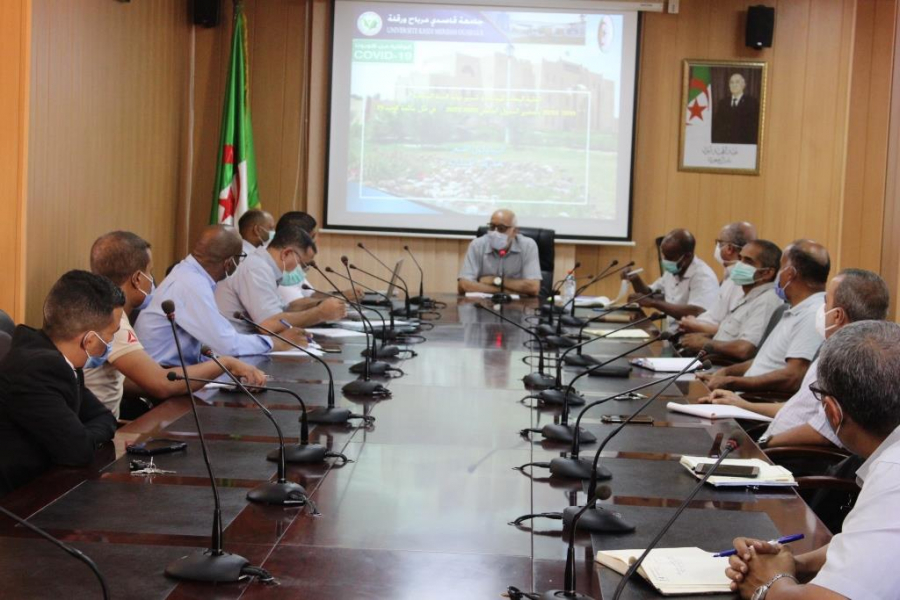
Within the framework of a good and healthy course to end the university year 2019/2020 and enter the next university 2020/2021 in light of the outbreak of the emerging corona virus (covid-19) the cell node meeting on August 12, 2020 to discuss the health protocol, which defined the procedures and operational method in adopting a health protocol to maintain health And the safety of the university family.
To be carried out at the university according to the number of students and the absorptive capacity of the university structures, and it came as follows:
Health Protocol:
Operational method
• The pedagogical aspect:
Continuing and enhancing distance education:
Maintaining the organization of distance teaching (lectures and applications), to complete the academic year 2019/2020, and this is particularly related to ending the teaching of horizontal units and exploratory units through distance education only
The students have access to Internet spaces and automated media while ensuring strict respect for physical distancing
Reorganizing the attendance education mixed with distance education to teach the basic units and methodology units (applied work), taking into account the specificity of the taught material, by providing the necessary health conditions and respecting the established standards, in consultation with the pedagogical bodies
Organizing attendance education through batches of students and for a closed period of time (two weeks), which allows student flows to be managed within the framework of respecting health standards, both at the university level and at the university residency level.
Beginning of attendance teaching in September 2020
Students' absences are not counted when resuming attendance classes (under study)
Organizing the applied work: According to the subjects taught and the specificity of each college, and after consulting the training teams, the conditions and the organization of applied work must be taken into account as follows:
Conducting applied work by simulation with presenting a summary of the work through electronic media or attendance with strict respect for standards and procedures
Recording of sessions of applied work that have been completed for presentation by the professors and presenting them on the line (this possibility allows the student to follow his applied work and submit reports on each session to the professor for evaluation via the line)
The possibility of postponing the applied work, in the event that it is not possible to conduct it and it is considered a debt that must be liquidated during the academic season 2021/2022, when circumstances permit.
The management of educational time:
Organizing lessons through batches of students with reducing numbers in each group and spacing in programming the various groups and utilizing the available time periods up to six o'clock (18:00) in the evening, while reducing the time allocated to educational sessions (maintaining the quality of training):
One hour (1 hour) for theoretical classes (lessons) and for directed business sessions
Two hours (2 hours) for the applied work sessions
Preference for flexible movement for students, who should only attend during their teaching sessions (review time distributions if necessary)
Organizing lessons in batches (according to the number of students):
First batch: From 06 September 2020 to 17 September 2020.
Levels concerned with:
First year BA (Common Trunks) exclusively.
All levels for students of the Institute of Technology.
All levels for students of the Institute of Science and Techniques of Physical and Sports Activities.
The second batch: from 20 September 2020 to 01 October 2020.
The third batch: from October 11, 2020 until October 22, 2020.
Note: Colleges can combine levels according to the following conditions:
Provides educational seats specified in the protocol standards (16 students per 50 square meters).
The percentage of progress in the lessons and the attendance class program based on the training team meeting minutes
The announcement of programming (for the group and the groups concerned) will be made before August 30, 2020, in all means of communication
The second semester exams:
The exams are scheduled according to the payment system, and that is as follows:
The first batch: from 03 October 2020 to 08 October 2020.
Note: Levels concerned with:
First year BA (Common Trunks) exclusively.
All levels for students of the Institute of Technology.
All levels for students of the Institute of Science and Techniques of Physical and Sports Activities.
The second batch: from October 24, 2020 until October 29, 2020.
Third batch: from 02 November 2020 to 07 November 2020.
The second semester comprehension exams:
The catch-up exams are scheduled during the exam periods for the next batch.
Evaluating students according to student batches, using all forms, and with the participation of all educational bodies, to organize regular course and catch-up exams:
Maximum 12 November 2020.
Organizing evaluation processes and examinations: In addition to the well-known evaluation methods, there is a possibility of renewal and introduction through training teams, flexibility in diversifying the forms of evaluation that allow respect for health rules, especially physical distancing, while fully ensuring respect for pedagogical standards.
The following may be suggested:
Reducing the duration of the examinations.
Assessment using multiple-choice questions and related approaches.
Some lessons can be evaluated through the work presented by the students.
The pattern of students ’evaluation (continuous evaluation, final examinations) is due to the evaluations of the pedagogical committees and the officials of the exploratory and occasional educational units, to finding other modes of remote evaluation.
Special cases of students due to an imperative reason. Their cases will be studied in particular by the educational teams. This group who was unable to pursue distance education due to lack of capabilities can study their cases. Participation in the remote evaluation, to address their issue in case of case (transfer of debts, repeat the year, without a calculated educational delay).
Setting up a system for advertisements and media at various levels, especially on digital platforms and social networks (time distributions, exam program, spreading scores, ...) with a plan for communication and communication.
A preference for flexible transportation for students, who should only attend during their educational lessons.
Standards to be respected:
- Strict respect must be observed, according to specializations, in all buildings designated for pedagogy (terraces for directed business halls and applied work laboratories) standard "The Framework", 16 students in an area of 50 square meters
Periodic sterilization of educational and administrative structures
Ensure ventilation and maintenance of places including toilets
Organizing movement (entry and exit) at the university and university residencies.
Preventing gatherings, especially in closed spaces.
Compulsory wearing of the muzzle and respect for the physical spacing of all members of the university family,
Double hand washing points (tanks for soap and water) and the possibility of providing lubricant and alcohol
The university family holds a responsibility to respect preventive measures
Organizing the daily attendance at the institution, and preventing the entry of strangers.
Setting up a system for advertisements and information, reminding of the preventive recommendations, to be published in all areas of the university and services
Developing recommendations and special means to protect reception workers and security workers, the main actors and main actors of the crisis management: awareness of risks, awareness of responsibility, information about social distancing standards, putting on masks, using sterilizers in sufficient numbers, rounding toilets and water points, ... etc.
Security aspect (university)
Organizing movement within the university and university residencies while preventing all forms of gatherings (directing the direction of student flows and avoiding intersections (movement direction - entrances and exits, ...)
Compulsory placement of the muzzle and respect for the physical spacing of all components of the university family (1.5 m distance)
Regular measurement of temperature upon admission to the university
Organizing the daily attendance at the institution, and preventing the entry of strangers without a visit justification.
Organizing the flexible movement for students, who should only attend during their teaching sessions (reviewing time distributions if necessary, taking into account the specificity of each college).
Ways to protect reception workers and security workers, the two basic actions in managing the crisis: awareness of the risks, awareness of responsibility, information about social distancing standards, putting masks, using sterilizers in sufficient numbers, bringing toilets and water points close, ...
The media and contact aspect (university)
Continuous awareness-raising processes for the components of the university family about respecting the precautionary and preventive measures, with a reminder of the restrictive rules that must be respected to protect teachers, workers and students.
Setting up a system for advertisements and media at various levels, especially on digital platforms and social media networks (time distributions, exam program, posting marks, ...), with a plan for communication and communication.
The introduction of a green line for the psychological accompaniment of the university family at the CAPU level.
Creating digital platforms: to request documents and programming discussions, complaints, suggestions and reception dates.
Continuous consultation and dialogue with the actors, educational bodies, student and trade union organizations, with their participation, as well as the educational and scientific bodies, in sensitizing the university family and following up on the operational plan.
Create an internal communication plan that is part of the business continuity plan.
The social aspect: (university services)
The necessity of respecting standards and commitment to implement them according to the health protocol:
Accommodation: The approved standard for utilizing rooms:
6 square meters for each student / 12 square meters for each two students / 18 square meters for each three students
Provide a space for the Internet and put it at the disposal of students
• Feeding
The recommended feeding is the "transportable meal" type in disposable containers, utensils and utensils.
The meals are distributed according to health standards,
Extending the hours of distribution of meals for the proper management of student flows in order to ensure the smooth running of the process.
Transport:
Respecting the transportation of a maximum of 25 students on the bus while ensuring multiple shifts of buses every day until six in the evening (18h) according to the educational lessons programmed by the university institutions, with close coordination with the educational interests
Medical sciences
In view of the specificity and sensitivity of training in medical sciences, preventive measures must be taken with the continuation of educational activities, and that is by:
Preventing students from entering medical facilities designated for patients with Covid-19,
Use of simulation equipment acquired for teaching and, in particular, applied work,
Non-actionable ambiguities due to Covid-19 are considered debts that must be liquidated when circumstances permit.
Use of audio-visual in directed works.
Continue your distance education through video lectures.
Note: For science and medicine students, the study will start:
On Sunday August 30, 2020.
General principles of the protocol and procedures for its implementation
The general principles revolve around:
Cleaning / sterilization, barrier procedures.
Exploitation of classrooms, stands, laboratories.
Receiving students in batches.
Managing the movement of students and employees.
Exploitation of university residencies management.
Taking care of suspected and confirmed cases.
Implementation depends on five key points:
Maintain physical spacing
Application of the septum signs
Reducing student mixing
Cleaning and sterilizing buildings and devices
Training, Information and Communication.
Calendar of resumption of educational activities
Starting August 16, 2020:
Appeal of administrative workers, maintenance and cleaning to prepare the pedagogical spaces
And the conditions for receiving students, in accordance with the standards and principles of the Protocol.
Reminding the university family of the "management protocol" system for the end of the 2019-2020 university season and preparing for the 2020-2021 university entrance, by using all means of communication.
On August 23, 2020 until August 30, 2020:
Signing the minutes of resuming work remotely, via the line, with the teachers ’commitment to continue the pedagogical activities that started since March 2020 remotely.
Inform students and professors about exceptional pedagogical programming (schedules for all batches according to reception periods, pedagogical meetings for training teams, programming discussions ... etc.), according to the protocol “framework” for running at the end of the academic year 2019-2020 with the use of all means of communication.
Resuming the activity of administrative workers according to the necessity of the department
On 01 September 2020 (Resume by doctoral students and second-year Master students)
Resumption of studies for second-year master students, as well as for students registered in the Ph.D.
Starting 06 September 2020
Continuing studies as an integrated "lectures and mentored work".
Since the lectures and directed works are compact, they can be given in attendance, with work to resume the study in person in batches for a period of two weeks, "intensive instruction" equivalent to "4 weeks":
First batch: from 06 to 17 September 2020
The second batch: from 20 September to 01 October 2020.
The third batch: from October 11, 2020 until October 22, 2020
Evaluating students according to groups using all means and with the participation of all educational bodies to prepare for regular and catch-up exams from October 03 to November 12, 2020.
Ensure that the initial results are published through all means of communication.
Organizing the deliberations according to the chronological order of the scheduled examinations, with a commitment to preventive measures and without prejudice to the regulatory laws in effect.
University entrance date 2020/2021: November 18, 2020.
First year BA: distance education
Other phases, preference for distance education.